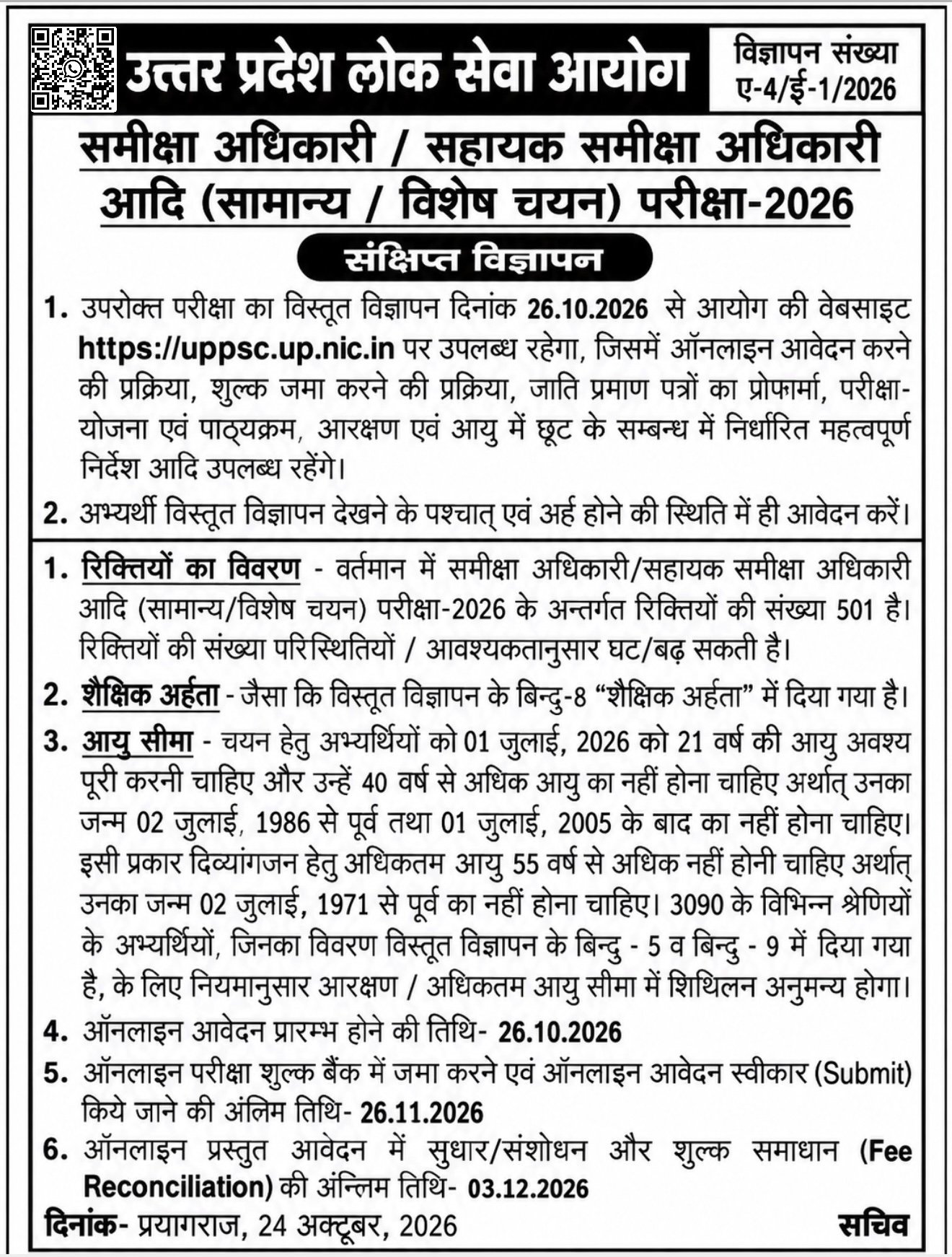
Job portals report that the Uttar Pradesh Public Service Commission (UPPSC) has issued a short notification for 501 Review Officer (RO) and Assistant Review Officer (ARO) posts, dated 25 October 2026. Online applications are reported to open tomorrow, 26 October, and close on 26 November 2026, with fee payment and corrections until 3 December. I have not opened the official PDF, and some portals still say the notification is only ‘expected’, so everything below is as reported and needs checking against uppsc.up.nic.in. The prelims date, the detailed syllabus, the pay level and the category-wise vacancy table are not published in anything I found.
What has been announced
UPPSC is recruiting Samiksha Adhikari (Review Officer) and Sahayak Samiksha Adhikari (Assistant Review Officer) for the U.P. Secretariat, the Board of Revenue and the Commission itself. Jobsarkariupdate, Haryana Jobs, Indianewjobs and Careerpower report 501 or 502 posts, with applications from 26 October. Testbook and Adda247 describe the notification as expected on 26 October. The reasonable reading is that a short notification is out today and the full advertisement and the application link go live with the opening of applications.
This is a fresh cycle, advertised as A-4/E-1/2026 according to reports, and it is separate from the 2023 recruitment, whose final result was declared provisionally on 5 April 2026. Anything you read about 2023 cut-offs, 2023 marks or the 2023 final list belongs to the old cycle.
Snapshot
| Item | Detail (as reported) |
|---|---|
| Organisation | Uttar Pradesh Public Service Commission |
| Posts | Review Officer (RO), Assistant Review Officer (ARO), including ARO (Accounts) at UPPSC |
| Vacancies | 501 reported (one outlet: 502, made up of 129 RO and 373 ARO) |
| Qualification | Bachelor’s degree; ARO also needs an O Level certificate and Hindi typing at 25 wpm |
| Age | 21 to 40 years as on 1 July 2026 |
| Fee | ₹125 General, OBC, EWS; ₹65 SC, ST, ex-servicemen; ₹25 PwD |
| Selection | Preliminary exam, mains, typing test (ARO), document verification; no interview |
| Applications open | 26 October 2026 |
| Last date | 26 November 2026 |
| Fee payment and correction | Until 3 December 2026 |
Vacancies
The reported split is 129 Review Officers and 373 Assistant Review Officers. Those add up to 502, one more than the headline of 501, and the portal that publishes both numbers says so itself. The ARO figure is also reported to include the ARO (Accounts) post at the Commission, which asks for a B.Com degree, but its separate count is not given. No category-wise table is available in what I read.
The numbers matter less than the ratio. ARO has nearly three times the seats of RO, and it also has more requirements, because of the O Level certificate and the typing test. A candidate who qualifies for both posts should look at the seat numbers, the department list and the competition before choosing, and if the application allows both, think about whether to apply for both.
Dates
| Event | Date |
|---|---|
| Short notification | 25 October 2026 |
| Applications open | 26 October 2026 |
| Last date to apply online | 26 November 2026 |
| Last date for fee payment and corrections | 3 December 2026 |
| Preliminary examination | To be notified |
The prelims date is not out, and the last cycle shows why you should not plan around a quick one. The 2023 advertisement of October 2023 produced its provisional final result in April 2026, about two and a half years later, after the first prelims was cancelled and held again. A candidate should expect the prelims to follow the application window by months, not weeks, and should use the time.
Eligibility
For Review Officer, a bachelor’s degree in any stream from a recognised university is reported. For Assistant Review Officer, a bachelor’s degree plus an O Level certificate from NIELIT or DOEACC, or an equivalent qualification, and Hindi typing at 25 words per minute. For ARO (Accounts) at UPPSC, a B.Com degree is reported.
The O Level condition decides who can apply for ARO at all. The reports describe it as mandatory. A candidate who has a degree but no O Level certificate on the closing date may not be able to apply for ARO, and since certificate exams are held periodically, it is not something to fix in a fortnight. If this is you, the practical alternative is the RO post, which asks only for a degree, but check whether the notification allows it and whether your preferences matter.
The reports do not say how the ‘equivalent’ computer qualification is defined. If you hold a diploma or degree with computer content instead of an O Level certificate, the full notification is where the list of accepted equivalents will be. Do not assume yours is accepted.
Choosing between RO and ARO
If you qualify for both, the choice deserves a few minutes. Review Officer has 129 seats and asks only for a degree. Assistant Review Officer has 373 seats and adds the O Level certificate, the typing test and, for the Accounts post, a B.Com degree. More seats mean better odds on paper, but the extra requirements also keep some candidates out, and the reports give no data on how many candidates applied for each post last time.
For the 2023 cycle, ExamDetail reported 6,093 candidates qualifying for the RO mains and 1,386 for ARO, against 338 and 81 final selections. That is close to eighteen candidates per seat in both. It suggests that having more seats in ARO did not make it much easier to win a place, though it is a single cycle and the 2026 numbers can differ. Pick the post whose duties and career you prefer, and for which you can meet every condition on the closing date, not the one that looks easier.
Age limit
The age range is 21 to 40 years, counted as on 1 July 2026. Relaxation for SC, ST, OBC and PwD candidates is reported as ‘as per UP Government rules’, with no figures given. Someone who turns 21 the day after the cut-off date is, on this reading, too young, and the notification’s own wording settles edge cases. If you are near either limit, read the age clause and the relaxation rules before paying anything.
Age proof is normally the Class 10 certificate. The date of birth in your one-time registration must match it exactly.
Application fee
The reported fee is ₹125 for General, OBC and EWS candidates, ₹65 for SC, ST and ex-servicemen, and ₹25 for PwD candidates, paid online or by SBI e-challan, and non-refundable. Payment is part of the application: a form without the fee is rejected, according to the reports.
Do the payment early and keep the receipt. The deadline for payment, 3 December, is later than the deadline for the form, but a candidate who leaves it to the last day is relying on a portal handling a statewide rush.
Selection process
The reported stages are a preliminary examination, a main examination, a typing test for ARO candidates, and document verification, with no interview.
Jobsarkariupdate describes the prelims as an objective test covering general studies and general Hindi, used only to shortlist for mains, and the mains as a descriptive test of general studies, general Hindi and drafting, and a Hindi essay, whose marks matter most for the final merit list. For the previous cycle, ExamDetail’s account of the 2023 advertisement gave a 200-mark prelims and a 400-mark mains, with one-third negative marking in the objective papers, and a minimum efficiency standard of 35 per cent for SC and ST candidates and 40 per cent for others. The 2026 notification may keep or change any of this, so read its scheme before you rely on those numbers.
The consequences are clear whatever the exact marks turn out to be. Mains carries the weight, and the written Hindi in it, which includes drafting and essay, is what separates candidates. A prelims score only gets you in.
The ARO typing test
The Hindi typing test is for ARO candidates only, is qualifying in nature, and asks for 25 words per minute, per Jobsarkariupdate. The reports do not say which keyboard layout or font will be used, how errors are counted or how long the test lasts.
That gap matters for practice. Hindi typists tend to learn either the older Remington layout used with Kruti Dev fonts or the Inscript layout used with Unicode fonts such as Mangal, and a person fast on one can be slow on the other. When the notification or a later notice names the layout, switch your practice to it. Until then, practise on the layout you know best, but do not assume it will be the one tested. Typing at 25 words per minute is a low bar, and a candidate who types accurately at 30 on any layout has room to adapt.
Pay and posting
The pay level is not stated in the reports. Jobsarkariupdate says outright that the official pay scale is not confirmed in the notification text it saw. Posts are in the U.P. Secretariat, the Board of Revenue and the Commission, and the application reportedly asks you to choose posts and departments in order of preference.
That preference list is the part to read twice. The reports do not say how preferences are used in allocation, whether merit decides, or whether you can change them later. Think about where you would be willing to work, and put the real order down, not a guess. Salary figures on any page that does not quote the notification’s pay level are not reliable.
How to apply
The steps reported are these.
- Complete the one-time registration (OTR) on the UP government’s OTR portal if you have not already done so. This is a prerequisite, and doing it before the application opens avoids a last-minute queue.
- Go to uppsc.up.nic.in and open the RO/ARO 2026 application link when it appears.
- Log in with your OTR credentials and fill in your educational and category details.
- Choose your posts and departments in order of preference.
- Upload your photograph and signature in the prescribed format.
- Pay the fee online or by SBI e-challan.
- Review the application and submit it.
- Download the confirmation and keep the fee receipt.
Details entered at the OTR stage often feed straight into the application. Enter your name, date of birth, category and qualifications exactly as they appear on your certificates, since a mismatch can cause trouble at verification, and I am inferring that the OTR data carries over.
Documents to keep ready
The reported list is a recent photograph, a signature scan, the bachelor’s degree and mark sheets, the O Level certificate for ARO, a caste or category certificate in the UP format, a domicile certificate and any other document the notification names. Scan them now at a legible size. If your category certificate was issued some time ago, check whether the notification requires a recent one.
Be careful which links you click
The Jobsarkariupdate page is useful for its summary, but look at where its links go. Its ‘Apply Online’ button leads to a WhatsApp channel, its ‘Download Notification’ button leads to a Telegram channel, and its short notification is a file on Google Drive. Those are the portal’s own channels and storage, not the Commission’s.
None of that makes the facts wrong, but it is a reminder of how to behave. Apply only on uppsc.up.nic.in and the OTR site it points to. Pay the fee only on the payment page inside the application. Do not follow a link from a messaging group, and do not pay anyone to ‘fill your form’. Also notice which commission you are dealing with: Testbook’s headline for this notification names upsssc.gov.in, which belongs to a different body, the UP Subordinate Service Selection Commission.
Common mistakes
A candidate who has no O Level certificate applies for ARO and is rejected. A candidate whose caste certificate is in another state’s format finds it refused. A candidate registers on a look-alike site. A candidate pays the fee on a page that is not part of the application. A candidate enters the wrong date of birth at OTR and then cannot make the application match their certificate. And a candidate treats the long gap before the prelims as a reason to wait, then finds the mains, with its Hindi drafting and essay, needs months of writing practice.
Why Hindi writing decides the mains
Whatever the final marks scheme, the reported mains papers include General Hindi and Drafting and a Hindi essay, and for the previous cycle those two together carried 280 of 400 marks. If 2026 follows a similar plan, the written Hindi is where candidates are separated, because general studies knowledge is spread more evenly across a field of graduates.
Drafting in this setting usually means official letters, notes and similar formats. Essays reward structure and clear sentences more than rare vocabulary. The most reliable preparation is also the least glamorous: write two or three pieces a week by hand, within a time limit, and have someone read them. A candidate who has done thirty such pieces by the mains will write faster and with fewer errors than one who has read about them.
A plan for the window
This is my suggestion, since the notification text I could read is incomplete.
Before 26 October: complete or update your OTR, collect your certificates, and decide which post you are eligible for. If you plan to apply for ARO, confirm your O Level certificate.
26 to 31 October: fill in the application carefully, with a calm check of every field, and submit it. There is no benefit in waiting for the last week, and the fee deadline gives you no extra time to apply.
From now until the prelims: begin writing practice in Hindi, with short essays and formal drafting each week, and read one good daily newspaper for current affairs. For ARO, add ten or fifteen minutes of Hindi typing every day.
What is not yet known
- The prelims date, pattern and negative-marking rule for 2026.
- The detailed syllabus and the mains scheme.
- The pay level for RO and ARO.
- Category-wise and department-wise vacancies, and whether 501 or 502 is correct.
- The keyboard layout and font for the typing test.
- How department preferences are used.
Important Links
| UPPSC RO ARO Recruitment 2026 Short Notice | Short Notice |
| UPPSC RO ARO Recruitment 2026 Online Form Link (From 26.10.2026) | Apply Online |
| UPPSC OTR Registration | OTR |
| UPPSC RO ARO Recruitment OLD Notification | Old Notification |
| UPPSC Official Website | UPPSC |
FAQs
Can I apply today? No. Applications are reported to open on 26 October 2026. Complete your one-time registration now so that you are ready.
I have a degree but no O Level certificate. Can I apply? The reports say an O Level certificate or an equivalent is mandatory for ARO. It is not listed as a requirement for RO. Read the notification for equivalents and for whether you can apply to RO alone.
Is there an interview? No. The reported selection process is prelims, mains, a typing test for ARO and document verification.
What is the age limit and the cut-off date? 21 to 40 years as on 1 July 2026, with relaxation for reserved categories as per UP Government rules. The relaxation figures are not given in the reports I read.
Is this the same as the 2023 recruitment? No. The 2023 cycle ended with a provisional final result in April 2026. This is a new recruitment with its own notification, and its cut-offs do not exist yet.