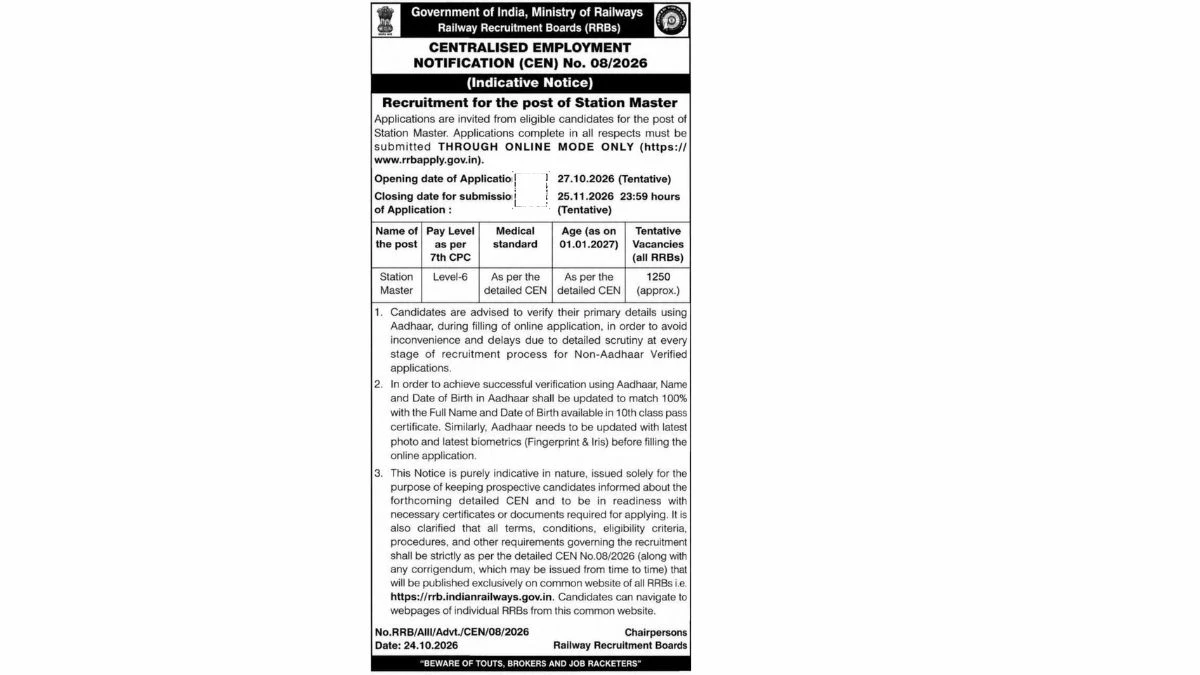
The revised Station Master syllabus is out in the form of Annexure A to Railway Board letter No. 2025/E(IRRB)/25/16 dated 7 October 2026: one 100-mark CBT of 120 minutes, followed by an aptitude test (CBAT). The Railway Recruitment Boards have also reportedly issued a short notice, CEN 08/2026, for about 1,250 posts on 21 October. The detailed CEN, the application window, the exam date and any negative-marking rule are not yet confirmed.
What has changed since the last update
Station Master has moved out of the NTPC graduate recruitment and into its own notification. Portals report that the short notice (CEN 08/2026) went up on rrb.indianrailways.gov.in on 21 October, with about 1,250 tentative vacancies at Pay Level 6, applications from 27 October to 25 November (tentative) and the detailed CEN expected around 27 October. One portal dates the notice 24 October, which cannot be right, since that date is still ahead, so treat the date discrepancy as a portal error. Age is counted as on 1 January 2027.
I could not open the Railway Board letter or the short notice. The RRB sites block automated access, and the letter is circulated through a link a portal hosts. The syllabus below follows that portal’s reproduction of Annexure A, and other portals list the same four sections and marks. The detailed CEN is the document that settles everything.
Exam pattern
| Item | Detail |
|---|---|
| Stages | Single-stage CBT, then CBAT, document verification, medical examination |
| CBT | 100 marks, 120 minutes |
| CBAT shortlist | Up to 8 times the vacancies, RRB-wise, on CBT merit |
| DV and medical | 1:1, RRB-wise, on combined CBT and CBAT merit |
| Final merit | 70 per cent CBT, 30 per cent CBAT, and only candidates who qualify in CBAT are considered |
| Section | Marks |
|---|---|
| Basic Science and Mathematics | 30 |
| Data Analysis and Interpretation | 30 |
| Logical Capability | 20 |
| Mental Reasoning | 20 |
The first two sections form a 60-mark “Basic Science, Mathematical and Analytical Capability” block. Negative marking has not been confirmed. One portal says “as per RRB norms, usually one-third”, which is the portal’s assumption and not text from the letter.
Detailed syllabus
Basic Science and Mathematics (30 marks)
Mathematics: number system, ratio and proportion, averages, percentages, profit, loss and discount, time, speed and distance, power and work, algebra, linear equations, arithmetic progression, LCM and HCF, geometry and trigonometry, areas and volumes, and probability and statistics at basic level only.
Science: units and measurements, mass, weight and density, work and power, energy, kinetic energy, friction, speed, velocity and relative velocity, heat and temperature, basic electricity, levers and simple machines.
Data Analysis and Interpretation (30 marks)
Multi-source data analysis, and examination, analysis and inference from text, tables and graphical data. The graphical forms listed are charts, graphs, scatter plots, pie charts, statistical curve distributions and Venn diagrams. Data sufficiency and data arrangement are also listed.
Logical Capability (20 marks)
Logical reasoning: binary logic, syllogism, clocks and calendars, assumptions, blood relations, family trees and logic-based puzzles.
Reading comprehension: passages and questions in English, drawn from history, society, literature, science, environment, abstract topics, mythology, technology and culture. Questions test the main idea, supporting ideas, application, and the logical structure and style of the passage.
Mental Reasoning (20 marks)
Analogy, series completion, coding-decoding, and ranking and arrangements.
What is gone, and what is new
General Awareness, which took up a full section in the NTPC pattern, does not appear in the reported syllabus. In the NTPC CBT-2 pattern reported for CEN 07/2026, General Awareness had 50 of 120 questions. That means static GK, current affairs and railway-specific facts may carry no marks in this paper. Candidates should confirm that in the detailed CEN before dropping them completely.
Three things are new. Basic Science appears as a subject. Data Analysis is a separate 30-mark section and no longer sits inside Mathematics. English reading comprehension enters a railway exam for the first time, as portals note. Together, science, mathematics and data analysis account for 60 per cent of the paper.
What the numbers mean for your time
With 100 questions in 120 minutes, you get about 72 seconds a question, well above the pace of earlier NTPC papers. That points to a paper that asks for more thinking per question, particularly in data analysis and comprehension, so accuracy will matter more than speed.
If negative marking turns out to be one-third, which is not confirmed, a guess pays only when you are at least 25 per cent likely to be right, since p − (1 − p)/3 reaches zero at p = 0.25. With four options, a blind guess has zero expected value. Wait for the CEN before settling your guessing strategy.
How I would weight preparation
This is my suggestion and not part of the notice. Divide time roughly in proportion to marks, but tilt towards your weak area:
| Area | Marks | Suggested share of study time |
|---|---|---|
| Data Analysis and Interpretation | 30 | About 25 per cent |
| Mathematics and Basic Science | 30 | About 25 per cent |
| Logical Capability, including reading comprehension | 20 | About 25 per cent |
| Mental Reasoning | 20 | About 15 per cent |
| Mock tests and review | About 10 per cent, rising near the exam |
Data analysis and mathematics give the largest block of marks, so they earn the largest share of time. Mental reasoning topics such as series and coding-decoding are quick to learn and easy to score, so they reward a short, regular practice.
Topic-by-topic notes
Mathematics. The list is arithmetic-heavy, with algebra, geometry and trigonometry at school level, and statistics and probability limited to basics. Arithmetic questions (percentages, speed and distance, work, profit and loss) usually repay speed work, and a few weeks of timed practice makes a difference.
Basic Science. The letter’s list is physics-oriented: units, density, work, energy, friction, heat, electricity and simple machines. The depth is not stated beyond “basic”. Class 9 and 10 physics textbooks are a reasonable benchmark, though that is my suggestion. Candidates from a commerce or arts background should start here, since science was absent from earlier NTPC papers.
Data Analysis and Interpretation. Thirty marks is as much as the whole of mathematics and science. Practise tables, bar and pie charts, line graphs, scatter plots and Venn diagrams, and multi-source sets where one answer needs two tables. Questions on data sufficiency and arrangement reward a careful reading of what is given. Such sets typically come with several questions on one data display, which makes a mistake in reading the table expensive, though the letter does not state the set structure.
Reading comprehension. The listed question types are the main idea, supporting ideas, application and the logical structure and style of a passage. That is a more demanding style than simple vocabulary-based English. Hindi-medium and regional-language candidates should start daily reading of English editorials or science and society articles now, and practise identifying the main idea in a sentence or two. The reproduction says passages and questions will be in English. Whether the rest of the paper is bilingual will be in the CEN.
Logical reasoning and mental reasoning. Syllogism, blood relations, clocks, calendars, puzzles, analogy, series, coding-decoding and arrangement are familiar territory for anyone who has prepared for banking or SSC exams. The difference is volume. Twenty marks each on two reasoning sections means 40 per cent of the paper is reasoning in some form.
CBAT is not part of the syllabus
The Computer Based Aptitude Test comes after the CBT and carries 30 per cent of final merit. It is not a subject-based test, so there is no CBAT syllabus in the sense of topics to read. It tests aptitudes, and the format and rules will come with the detailed CEN. Be wary of “CBAT syllabus PDFs” being sold before that. The only reported rule is that you must qualify in it to appear in the final merit list. For the ALP CBAT, the boards reportedly use a minimum T-score in each battery, but the Station Master rule has not been published in what I read.
An eight-week plan, if you start now
- Weeks 1 and 2: Science basics from school textbooks, plus arithmetic fundamentals. Begin one reading comprehension passage a day.
- Weeks 3 and 4: Data analysis: tables, bar and pie charts, line graphs, then multi-source sets. Algebra, geometry and trigonometry basics.
- Weeks 5 and 6: Logical reasoning and mental reasoning drills. Sectional timed tests in each of the four sections.
- Week 7: Full 100-question mocks in 120 minutes, with a review of every wrong answer and every question that took too long.
- Week 8: Revision of formulas and weak topics, and two more full mocks.
If the exam date turns out to be later, extend the middle weeks and keep daily reading and data-analysis practice going throughout.
Previous year papers and cut-off
There is no previous paper in this pattern, since the single 100-mark CBT with these sections is new. Old NTPC CBT cut-offs measured a different paper with General Awareness in it, so they are not a guide to this exam. No cut-off is quoted here, because none exists yet and I did not find a verified figure that applies.
Where portals disagree
Portals describe the sections in slightly different ways, such as three sections (60, 20, 20) or four (30, 30, 20, 20), but the marks are the same. The “usually one-third” negative-marking line, the exam date and the application dates are not from the letter. One portal says age is 20 to 30 and others say 20 to 33, including a three-year relaxation, which is the figure reproduced from the letter. The detailed CEN will fix all of these.
Important Links
| Link Description | Link |
|---|---|
| Official Notification PDF | Download RRB notification PDF |
| Apply Online | Apply online for RRB Recruitment 2026 |
| Official Website | Visit RRB official website |
FAQs
Is General Awareness in the Station Master exam?
Not in the syllabus as reported from the Railway Board letter. Confirm in the detailed CEN.
Will there be negative marking?
Not confirmed. The letter’s reproduction does not state it, and “one-third” on some portals is an assumption.
Has the syllabus been officially notified?
The syllabus is reported from the Railway Board’s letter of 7 October 2026. The detailed CEN, reportedly due around 27 October, will carry the authoritative version.
Is there a separate syllabus for CBAT?
No topic syllabus has been published. It is an aptitude test, and the CEN will describe its format and qualifying rule.
Do I need a science background?
The syllabus lists basic science at an unspecified level. Class 9 and 10 physics is a sensible benchmark, but the CEN should be checked for the level.